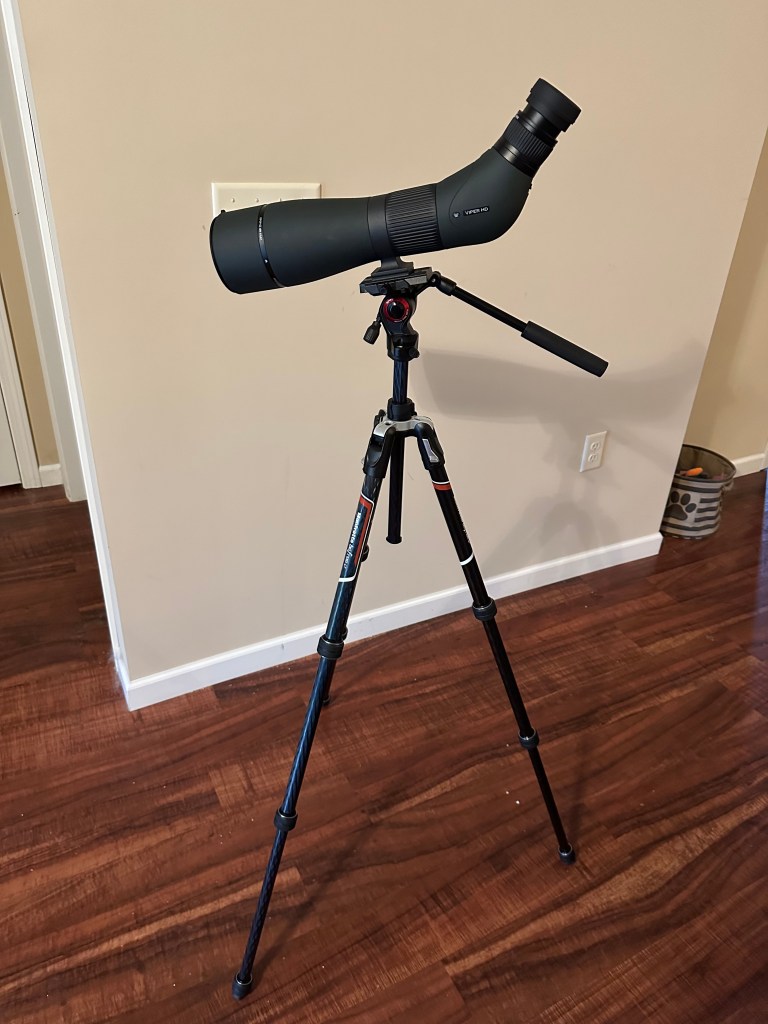
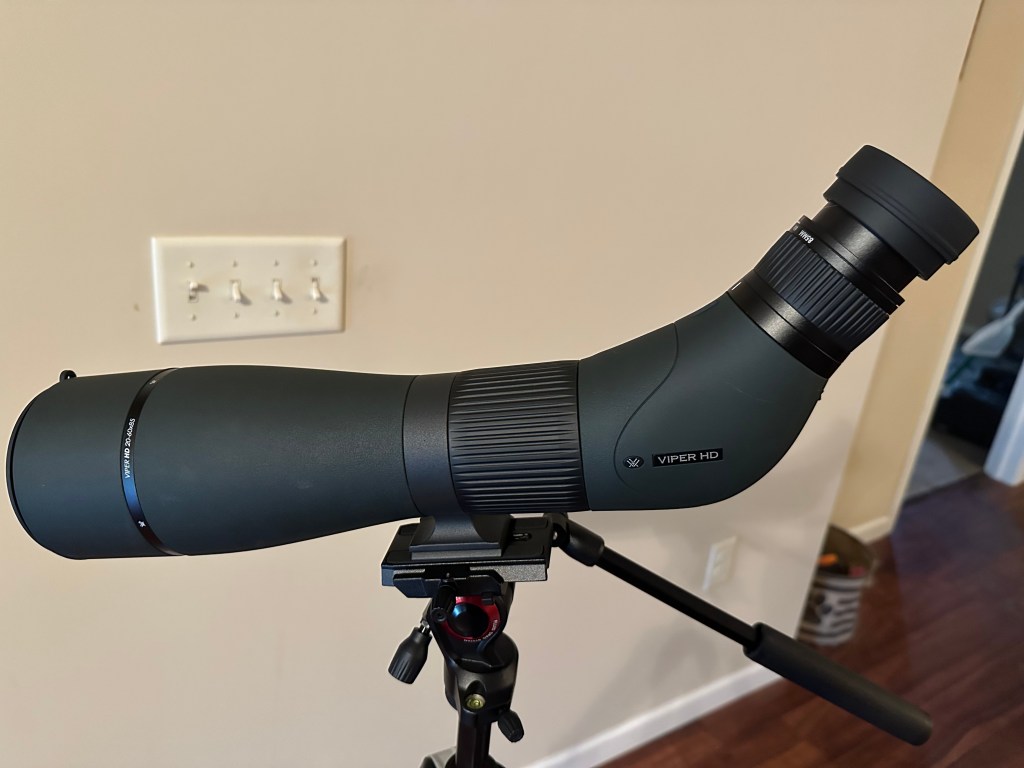
Today I finally completed my new spotting scope set-up. As I had mentioned in a post just prior to this, I had decided to return the tripod/head combination that I originally bought because of weight, and went with a new set-up. I purchased the Manfrotto Befree GT Carbon Fiber Travel Tripod, and the Befree Live Video Head. Total weight for both the scope, and the tripod combo is 8.2 lbs., a manageable weight in the field.
There definitely is a heft difference between my first purchase and this tripod/head combination. I think that there’s a bit more plastic employed in the Befree combination than the 055 tripod, which frankly is built like a tank for big video cameras. I’ve always had the unfortunate habit of over-buying in tripods, and this one certainly is different. It is very lightweight, and the head does suffer from some design flaws, notably if you are right-handed; I expect it easier for lefties, as the plate-locking mechanism and the tilt knob are both on the left side. And you can only mount the handle on the right side. My initial feeling is that the video head is a tad flimsy, but it is rated to hold 8.8 lbs. and my scope weights in a 3 lbs. less, so things should be fine. I will soon be doing reviews of both when I am able to get them out into the field.
On Monday morning, I scoped my 200th species in Ohio, the Eurasian Wigeon. This pretty duck was of course buried within a flotilla of Ring-necks, Mallards, Pintails, Canada Geese, and American Wigeons. He kept ducking behind other birds and diving, and was quite difficult to track for all of us birders there trying to tick him off our lists. But I finally did see him cross my field-of-view a few times. A pretty bird, rusty red head with cream line down the middle, a rosy-colored breast, he mixes in well with Redhead, but is a light gray overall with a white wing patch. This was at the Congress Road bridge over the Mogadore Reservoir, NE Ohio. Photo below by Joe Kollar from eBird:
Monday was also the first time that I used my spotting scope in the field. There was some good news and some bad news associated with it. The good, great, news is the performance of the Vortex Viper HD spotting scope: excellent field-of-view; clear, bright and crisp display; focus and zooming actions both very responsive and easy to operate… everything’s intuitive. The scope even comes with a case, which is kind of cheap and I don’t run with it, after all it’s waterproof right? This scope performs admirably when compared to my former scope, the Zeiss Victory Harpia 95.
The bad was the tripod. I just simply overbought, especially with the Manfrotto 502AH video head; it’s simply too heavy for me, and rather difficult to figure out and operate. Everything is too big on it, and I really didn’t like it. Also the legs – the Manfrotto MT055CXPRO3 carbon fiber tripod – is a bit too unwieldy to use in the field and also a bit too heavy to be lugging around. Overall tripod/head weight comes in at 8 lbs… plus the scope, that’s 12.8 lbs total. And I did research the hell out of this, but tripods are so difficult to figure out, especially as there are so many tripod models and separate panning heads to choose from. But at the end of Monday, I knew they had to go and I had to lighten my load.
So back to the webs and looking around, reading specs and reviews all over again. Interestingly, Manfrotto makes a backpacker carbon fiber tripod, which I checked out and also spoke with a B&H salesman about. Why didn’t I see this in my first search?? It’s called the Manfrotto Befree GT Travel Carbon Fiber tripod, and is sold only as a set with a different type of head. Its general weight with attached ballhead is 3.40 lbs., and it extends fully to 63.8″, perfect for me. Because of the packaging combos, I had to purchase a separate head, the Manfrotto Befree Live Videohead, for tilt/pan activities. It’s got an 8.8 lb. load capacity and weighs only .8 lbs. The tripod/panhead combo should weigh the same at 3.4 lbs., likely lower since the ballhead should weight more. So that’s a total combined weight of 8.2 lbs., and I am expecting it to come in under that, again depending on what the ballhead actually weighs. That’s a total weight reduction of over 4 lbs.! I went ahead and ordered the tripod and the panhead, and I should have them tomorrow, to take into the field on Friday.
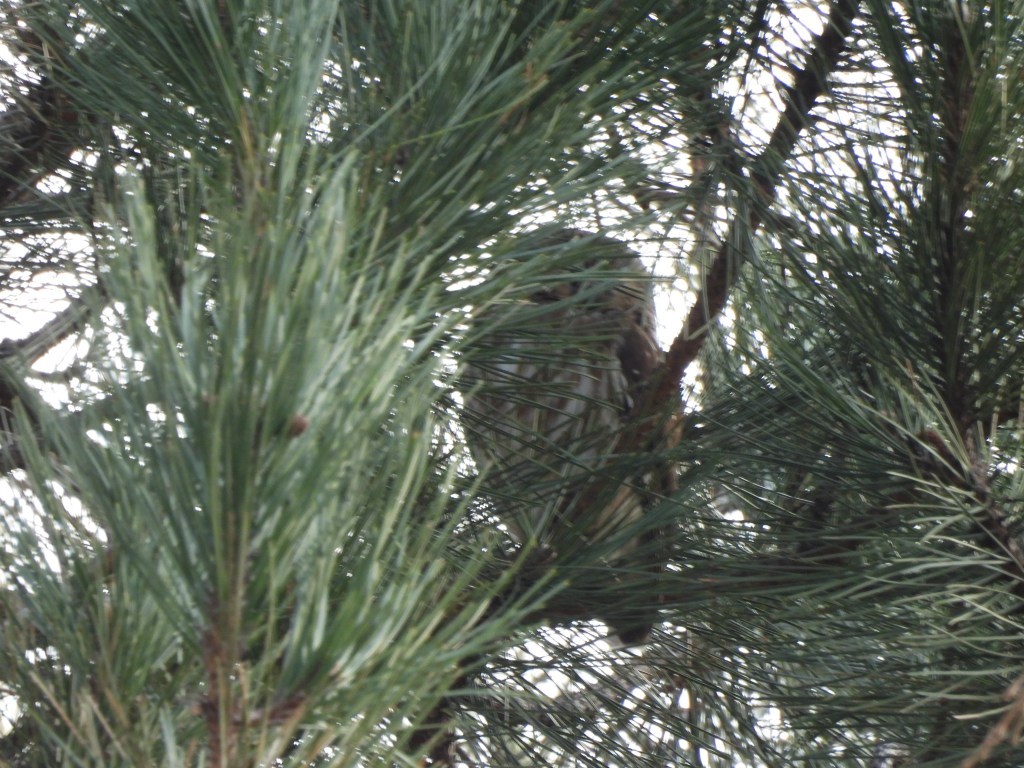
This morning, I went to the Cleveland Lakefront Nature Preserve, an 88-acre park located on Lake Erie to the west of Cleveland proper. The highlight was two Northern Saw-whet Owls, gray morph, perched high above on their respective pine trees. They are so small and so cute, and it was great to view them this morning, along with other species including immature Red-shouldered Hawk, White-throated Sparrow, Carolina Wrens and Dark-eyed Juncos bathing and playing in the streams. I then went to Fairport Harbor and got FOY Bufflehead, so it was a very good day for me. I’m now at 40 FOY species, but who’s counting. Not the best shot below, but you can see him/her….
Today I also started taking a look at getting a new, real spotting scope. I was out today with my camera, and at the high end of zoom, it did not work as well as I thought it would. I had also bought a very cheap 25-75×60 spotting scope from Temu, paid only $53 for it and figured what the hell, give it a try. It’s very dark and not unusually sharp at, well, any distance. But now, I am looking at 20-60×85 Vortex Diamondback as it’s in my price range. I was also looking at the Nikon ProStaff in the same range, and the sales associate at Optics4Birding commented that it was basically a crap scope for $599. There’s so many different models and hard to tell the differences between them.
If figuring out what spotting scope weren’t hard enough, the next pick is a tripod. Things like height and weight really matter, as well as what tripod head it comes with. Carbon fiber is the lightest, and also the most expensive, and it would be easy to buy a scope that is more expensive than the scope itself. Gitzo and Manfrotto are the most expensive tripod systems to buy, are also the lightest. Aluminum tripods are the most reasonably priced, but also heavier and sometimes not as sturdy.
So I will be evaluating all of these things while considering the purchase of a new spotting scope system.



 KeriBirder