Not a good day

Yesterday was a very promising day. Great weather and several hotspot stops planned, all around Shreve. I was planning to hit up Killbuck-Wright Marsh, Killbuck-Cemetery Road, Funk Bottoms and Wilderness Road. Since it promised a beautiful day, it should have been a great day of birding.

I headed out before sunrise, stopping to get water and a breakfast sandwich at McDonalds, and a coffee from Dunkin. Traffic was great, and I found myself in the parking lot of Wright Marsh just as the sun was rising. Greeted by the melody of a Song Sparrow, I got my spotting scope set up, put on my bins and headed out to the marsh. I arrived at the northernmost two ponds already having seen a good number of Ring-necks, and also many Red-wing Blackbirds and Song Sparrows; the sparrows seemed to be everywhere all at once.

I scoped the northern ponds and came up with the usual, well what I call usual, suspects: Northern Shovelers, Canada Geese, more Ring-necked Ducks, American Wigeons, Green-winged Teal, Northern Pintails. The one bird I was patiently scanning for – the Eurasian Wigeon – I could not locate. I felt like the inferior birder for not being able to find the Wigeon, as I’ve noticed I feel continually like the inferior birder. Then something strange happened.

As I was scoping for ducks, I suddenly felt ill, like my system was going to shut down and I was going to pass out. Pass out right there in the middle of the marsh. All I had been doing for the past ten minutes was looking through my scope. At the same time I felt sick, my iWatch vibrated and alerted me to the fact that my pulse had been above 120bpm for longer than ten minutes. I stopped what I was doing, and as I was shaky, thought maybe I need protein, so I popped a ClifBar and ate half of it. After a few minutes, I felt a little better but not totally solid on my feet. I made the tough decision to call it quits for the day, and shakily hiked back out to my car, from which I called my doctor for an appointment. In addition to this episode, I’ve been suffering for a while from loss of breath after doing the littlest of things. Then I headed home, feeling very defeated over the Wigeon and having to cut very short my trip.

I noticed when I got home that my heart rate was remaining high and was not coming down below 120bpm. Having not received a call-back from my doctor, I decided reluctantly to go to the local ER. This really did not go well in my opinion. I explained everything to the ER doctor, who simply had an attitude towards me, and he ordered tests. I had an EKG, chest x-ray, and blood work examining my enzymes, and everything came back normal. They gave me meds to lower my bp, and an IV infusion, and my heart rate finally came down. All of the tests – for a heart attack – came back negative and I was released. Released without any sort of explanation of any cause whatsoever. I just feel that the doctor didn’t listen to me, and I was taken for granted as a “needy” patient. Meantime, I’m worried about some arterial blockage. Anyways…

So, in the end it turned out that the Eurasian Wigeon was there in Wright Marsh all along, but in a different pool to the south. And it turned out that there were White Pelicans at Funk Bottoms. And still further, shorebirds flew into Wilderness Road… Pectoral Sandpipers were seen. Damn.

Yeah, the birds will be around again, but it makes me feel distressed, like I am not the strong birder I would like to think of myself. Only two days before I was looking at a Neotropic Cormorant, only to wait for someone to confirm that that was the bird. I just want to be a good birder, and after 50 years of doing it on and off, my trust in myself gets shaken – I was so strong a birder at 12 than I am now, or so it seems. And I wish that I had someone to bird with. It gets lonely birding by self after awhile, but the way most of the “top” birders operate around here, you’re not invited unless you have something to offer and/or are in the top counts yourself. Trust me, I’ve been turned down by several I’ve wanted to bird with for their expertise, one who had over 300 birds seen in Ohio for a year. Should it ever come to pass that someone will ask to bird with me, I promise to never do that. And that’s all I will say about that.
A Golden Swan…

I’ve been doing a lot of birding lately. In the last week, I managed to get to Chagrin River Park, Nimisila Reservoir, Portage Lakes Turkeyfoot Lake, Killbuck Marsh-Wright Marsh, and Sandy Ridge Reservation. I got lots of FOY birds, and my count for the year is now at 62, an ok-enough number. Not that I’m birding for my count.

I went to a new birding hotspot for me on Sunday, the Wright Marsh in Wayne County, southwest of Wooster. It was not fun. There are two entry areas, and the first is at a deadend with a small lot for cars. I parked there, got the scope all set up, and headed out. this was a close to bushwhacking I’d ever done, walking down a tight path leading into a wide open field of scrub brush and long grasses. I just stood there for a bit; I could see the marsh, but wasn’t sure of where to go. I walked a bit toward the marsh on what appeared to be a very basic trail, and then I just stopped. It was likely the first time I didn’t feel safe. I wasn’t overly certain of the path back and I decided to go no further. So I walked back to the car, and on the way flushed a Woodcock! FOY!

Now the reason for my going to Wright was to hopefully see a Bewick’s Tundra Swan. It’s a eurasian Tundra Swan, marked by a large patch of yellow on the base of the bill by the eye, nearly 50% of the entire bill, and is a rarity. After getting back to my car, I drove to the second egress into the marsh. Hoisting the scope on my shoulder, I headed out to see what I could. This particular part was diked into several areas, and it was the furthest pond that people were gathered at. The reports from the day prior were more than 120 Tundras plus the Bewick’s. I got to the end by the pond where they were reported, only to learn that about an hour before, they had all flown away. Not a single swan was present. Tallk about timing, as the Bewick’s was with the flock, and now gone. It just made for a bad day overall. I stayed for awhile, looking at all the Canada Geese, some Wigeons and Pintails, and that was about it for me. I had had it, so I drove home.

Today was a decent day at Sandy Ridge. Its been a beautiful day, 70F in early March and full of sunshine. Surprisingly, I didn’t see any of the usual suspects; Downy Woodpecker, Tufted Tit, Nuthatch – I didn’t even hear one. But it was a good day for ducks, with American Wigeon, Hooded Merganser, Ring-billed Duck, Lesser Scaup, and FOY Northern Shovelers. I also got to watch a wonderful Cooper’s Hawk soar in the sky above me, and that was picturesque. A pair of Eastern Bluebirds seemingly followed me around the walkway, singing loudly on a branch about six feet away from me. Canada Geese were nesting all over, and many couples were looking for an appropriate nesting place. And there were two Tundra Swans, so majestic even in their molt, their loud honking calls going as they took off in flight to another part of the large pond. But still no warblers yet.

At Portage Lakes I got a number of different duck species, a whole gaggle of Coots – there seems to be Coots all over the place – and the special bird, Horned Grebes. At Nimisila, I continue to check for the return of Yellow-rumped and Pine Warblers, but nothing as yet. The Double-crested Cormorants are back to begin nesting on their special tree. Today I went back to Nimisila to follow a report from yesterday of an Eared Grebe, but I dipped.

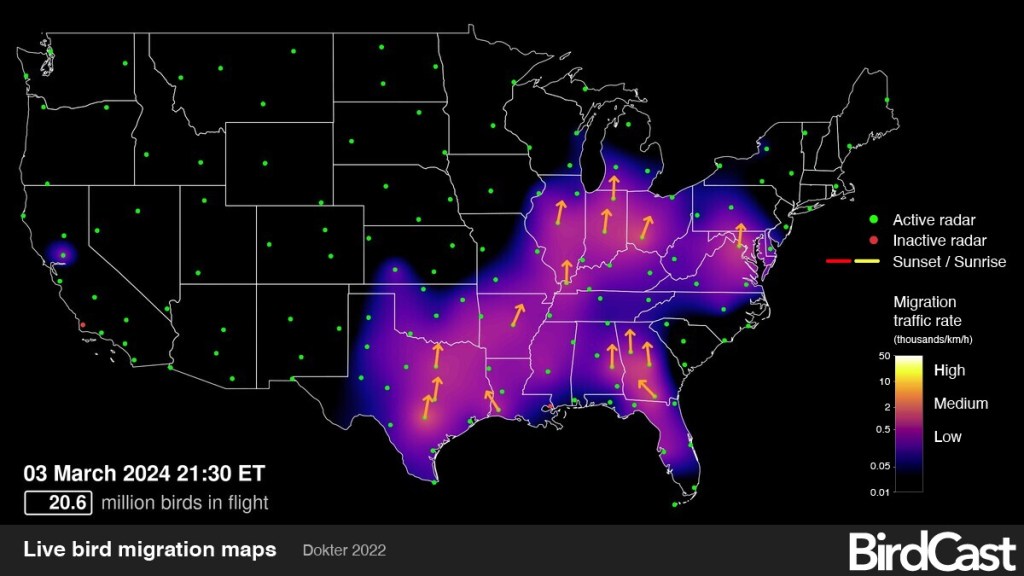
Here’s the latest mosaic for March 3rd…. movement is really starting to pick up!

Chagrin and migration

Yesterday I traveled to Chagrin River Park. I haven’t been there in a really long time, and it was fun to be back there birding. The park has not changed much in the over three years since last there, except for a bit of an expansion of its boggy and pond parts; more water seems to have filled in, which was nice as I saw three Mallards there. Sadly, the Screech Owl was not visible in any of the nesting boxes, so that was a dip on him, and the one bird I really had wanted to see – Rufous-sided Towhee, yes I still call it that – was also a dip. But I did manage to tick over 20 species, led by the cute, fun White-throated Sparrow. They were all over the park yesterday, as were the resident locals, including Tufted Titmouse, White-breasted Nuthatch, Black-capped Chickadee, and Northern Cardinal. The Nuthatches and Chickadees are so tame that I managed to get very close to them, and that was fun. Next time, I have to remember to bring seeds with me; they will eat out of your hand. One FOY bird I did manage to see were Common Grackle, so I now have 54 species for the year, which is fine considering I started late in earnest.

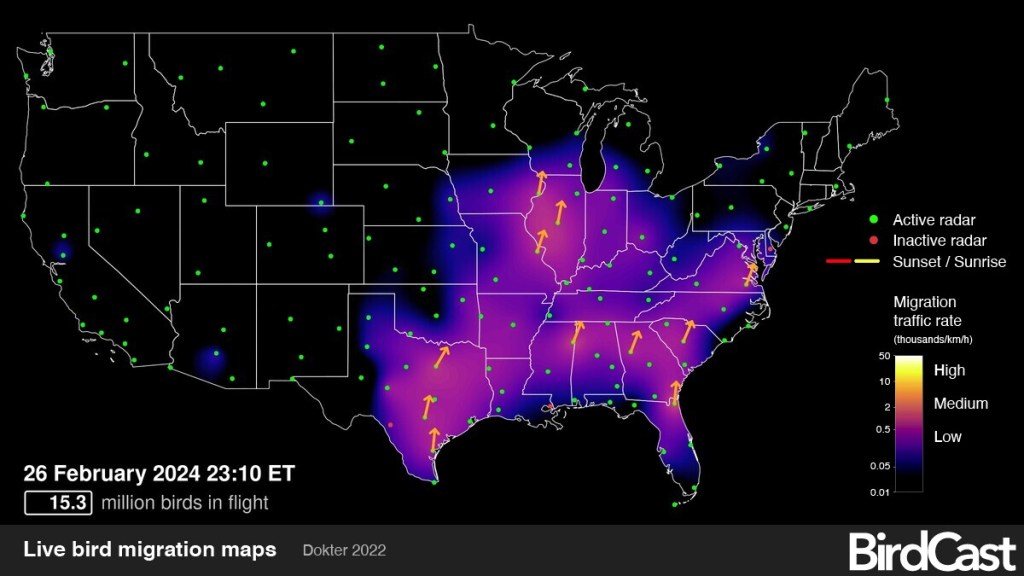
As for migrants, a smattering of warblers is showing up at various places in the state; Yellowthroat, Pine, Palm, the usual suspects early on. Killdeer have also been reported, as have Lesser Yellowlegs, so movement is occurring. I checked my Nimislia Reservoir hotspot the other day, but no Yellow-rumped Warblers in sight, nor anything else actually. I’m figuring in a couple of weeks, the Yellow-rumped will be back, as well as the Pine, which loves the very tall pine trees there. In terms of movement, BirdCast does have their national live migration map up and running and here is the look from late last night:

So I expect activity to pick up significantly in the next couple of weeks as we continue with duck migration, and enter into shorebird movement. Overall, I am wondering if this year will be an early migration for everything due to climate change – it’s a 59F February day here right now in NE Ohio. It will be interesting to see when peak migration of warblers is this year; in 2020, on May 16th, I had a 76 species day with 19 warbler species. I’m hoping to blow that record apart this year.

May for me is really going to be busy. Thinking of my birding schedule, the festival days start off next month on the 9th with the Shreve Migration Sensation, then take a break until May 8-10th, when I’ll be out at the Biggest Week in American Birding, my very first time attending. The following weekend is the Mosquito Lake Big Birding Weekend, where I’ll be participating in bird walks both Saturday and Sunday. Interspersed with these May events will be several trips to Mentor Lagoons, Headlands Dunes State Park, and Wendy Park, looking for migrants. My targeted species this year is the Golden-winged Warbler, along with Kirtland’s and Cerulean. I am also hoping to catch a Marbled Godwit this spring as well. I should see a Kirtland’s because on my trip to Grayling, MI in early June, but I would really love to see it at Magee beforehand. I am also truly hoping to see a Golden-winged this year, as 2020 was the last time I saw my favorite warbler.

200th Ohio Species…

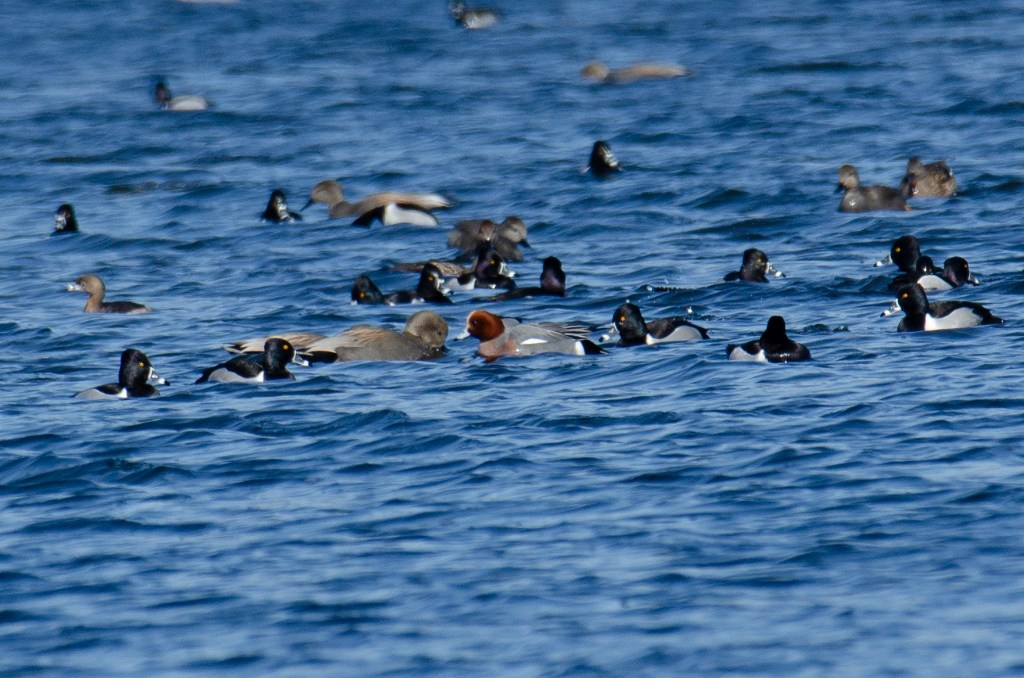
On Monday morning, I scoped my 200th species in Ohio, the Eurasian Wigeon. This pretty duck was of course buried within a flotilla of Ring-necks, Mallards, Pintails, Canada Geese, and American Wigeons. He kept ducking behind other birds and diving, and was quite difficult to track for all of us birders there trying to tick him off our lists. But I finally did see him cross my field-of-view a few times. A pretty bird, rusty red head with cream line down the middle, a rosy-colored breast, he mixes in well with Redhead, but is a light gray overall with a white wing patch. This was at the Congress Road bridge over the Mogadore Reservoir, NE Ohio. Photo below by Joe Kollar from eBird:

Monday was also the first time that I used my spotting scope in the field. There was some good news and some bad news associated with it. The good, great, news is the performance of the Vortex Viper HD spotting scope: excellent field-of-view; clear, bright and crisp display; focus and zooming actions both very responsive and easy to operate… everything’s intuitive. The scope even comes with a case, which is kind of cheap and I don’t run with it, after all it’s waterproof right? This scope performs admirably when compared to my former scope, the Zeiss Victory Harpia 95.

The bad was the tripod. I just simply overbought, especially with the Manfrotto 502AH video head; it’s simply too heavy for me, and rather difficult to figure out and operate. Everything is too big on it, and I really didn’t like it. Also the legs – the Manfrotto MT055CXPRO3 carbon fiber tripod – is a bit too unwieldy to use in the field and also a bit too heavy to be lugging around. Overall tripod/head weight comes in at 8 lbs… plus the scope, that’s 12.8 lbs total. And I did research the hell out of this, but tripods are so difficult to figure out, especially as there are so many tripod models and separate panning heads to choose from. But at the end of Monday, I knew they had to go and I had to lighten my load.

So back to the webs and looking around, reading specs and reviews all over again. Interestingly, Manfrotto makes a backpacker carbon fiber tripod, which I checked out and also spoke with a B&H salesman about. Why didn’t I see this in my first search?? It’s called the Manfrotto Befree GT Travel Carbon Fiber tripod, and is sold only as a set with a different type of head. Its general weight with attached ballhead is 3.40 lbs., and it extends fully to 63.8″, perfect for me. Because of the packaging combos, I had to purchase a separate head, the Manfrotto Befree Live Videohead, for tilt/pan activities. It’s got an 8.8 lb. load capacity and weighs only .8 lbs. The tripod/panhead combo should weigh the same at 3.4 lbs., likely lower since the ballhead should weight more. So that’s a total combined weight of 8.2 lbs., and I am expecting it to come in under that, again depending on what the ballhead actually weighs. That’s a total weight reduction of over 4 lbs.! I went ahead and ordered the tripod and the panhead, and I should have them tomorrow, to take into the field on Friday.

Shreve Migration Sensation

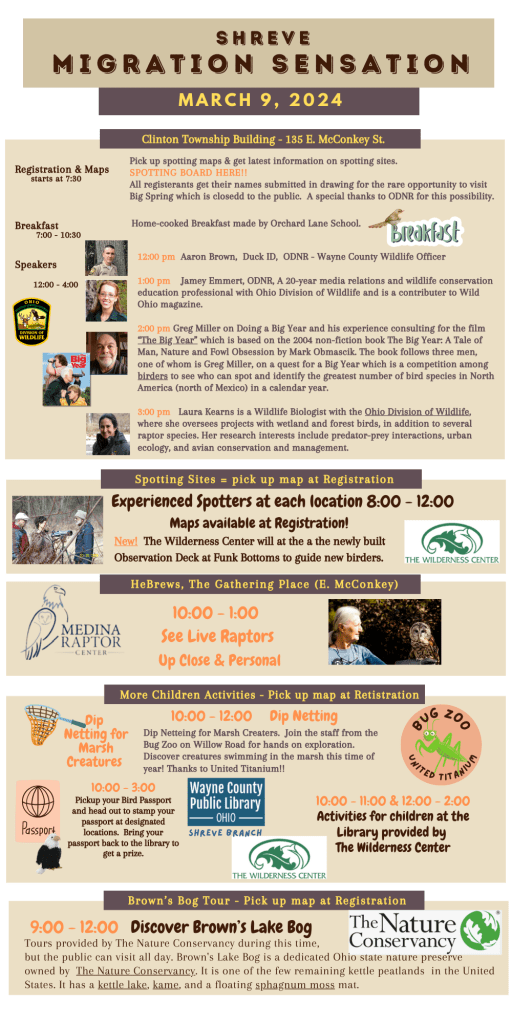
The Shreve Migration Sensation is a smaller, local birding festival lasting one day, in Shreve, Ohio. They are offering a breakfast, and various birding stations around Shreve, including Funk Bottoms. I’ve never birded there, so I’m looking forward to going, and especially the prospect of meeting Greg Miller. Below is the latest flyer. You can register in advance here.

Cute little Owls

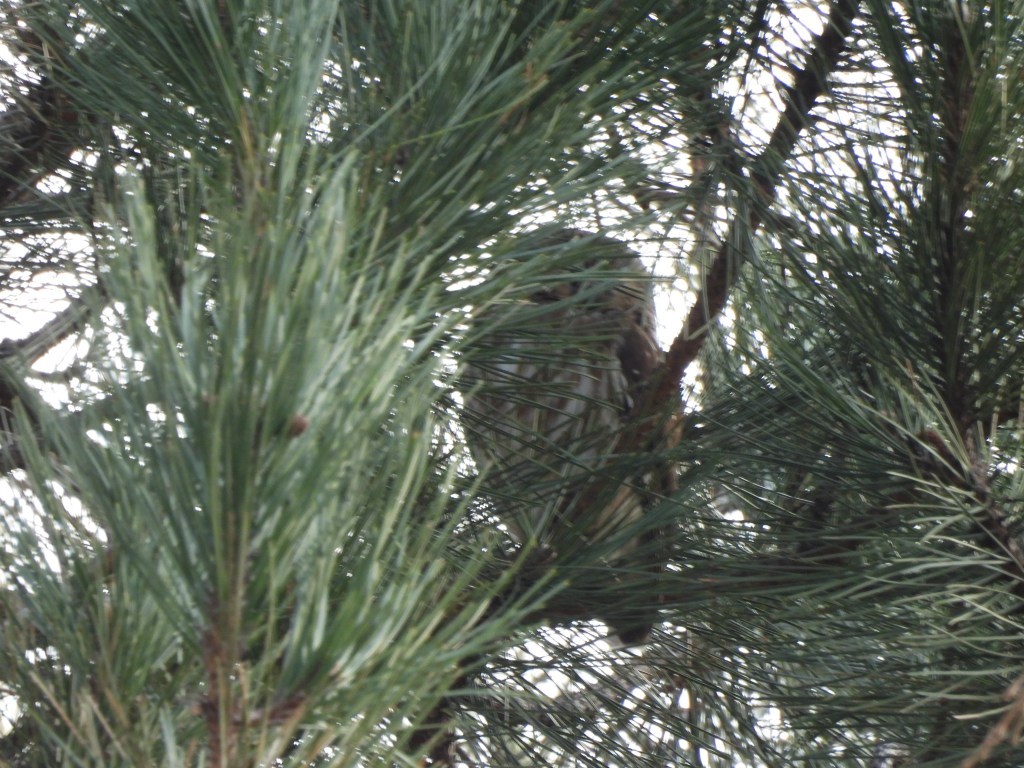
This morning, I went to the Cleveland Lakefront Nature Preserve, an 88-acre park located on Lake Erie to the west of Cleveland proper. The highlight was two Northern Saw-whet Owls, gray morph, perched high above on their respective pine trees. They are so small and so cute, and it was great to view them this morning, along with other species including immature Red-shouldered Hawk, White-throated Sparrow, Carolina Wrens and Dark-eyed Juncos bathing and playing in the streams. I then went to Fairport Harbor and got FOY Bufflehead, so it was a very good day for me. I’m now at 40 FOY species, but who’s counting. Not the best shot below, but you can see him/her….

Today I also started taking a look at getting a new, real spotting scope. I was out today with my camera, and at the high end of zoom, it did not work as well as I thought it would. I had also bought a very cheap 25-75×60 spotting scope from Temu, paid only $53 for it and figured what the hell, give it a try. It’s very dark and not unusually sharp at, well, any distance. But now, I am looking at 20-60×85 Vortex Diamondback as it’s in my price range. I was also looking at the Nikon ProStaff in the same range, and the sales associate at Optics4Birding commented that it was basically a crap scope for $599. There’s so many different models and hard to tell the differences between them.

If figuring out what spotting scope weren’t hard enough, the next pick is a tripod. Things like height and weight really matter, as well as what tripod head it comes with. Carbon fiber is the lightest, and also the most expensive, and it would be easy to buy a scope that is more expensive than the scope itself. Gitzo and Manfrotto are the most expensive tripod systems to buy, are also the lightest. Aluminum tripods are the most reasonably priced, but also heavier and sometimes not as sturdy.

So I will be evaluating all of these things while considering the purchase of a new spotting scope system.

New new year and days…

Well… its been a long time since I have written anything here. I had my absolute best year in 2020, but became disillusioned with a few things and actually quit birding since that time. I would occasionally look out for birds on my trips around the state, but no serious birding for me at all. I even sold my Zeiss spotting scope, and my beloved Zeiss Victory SF bins, which I could kick myself about. But with the opening of 2024, I’m back to birding, and I don’t really care about max numbers of species seen or any competitive stuff, I just want to see the birds.

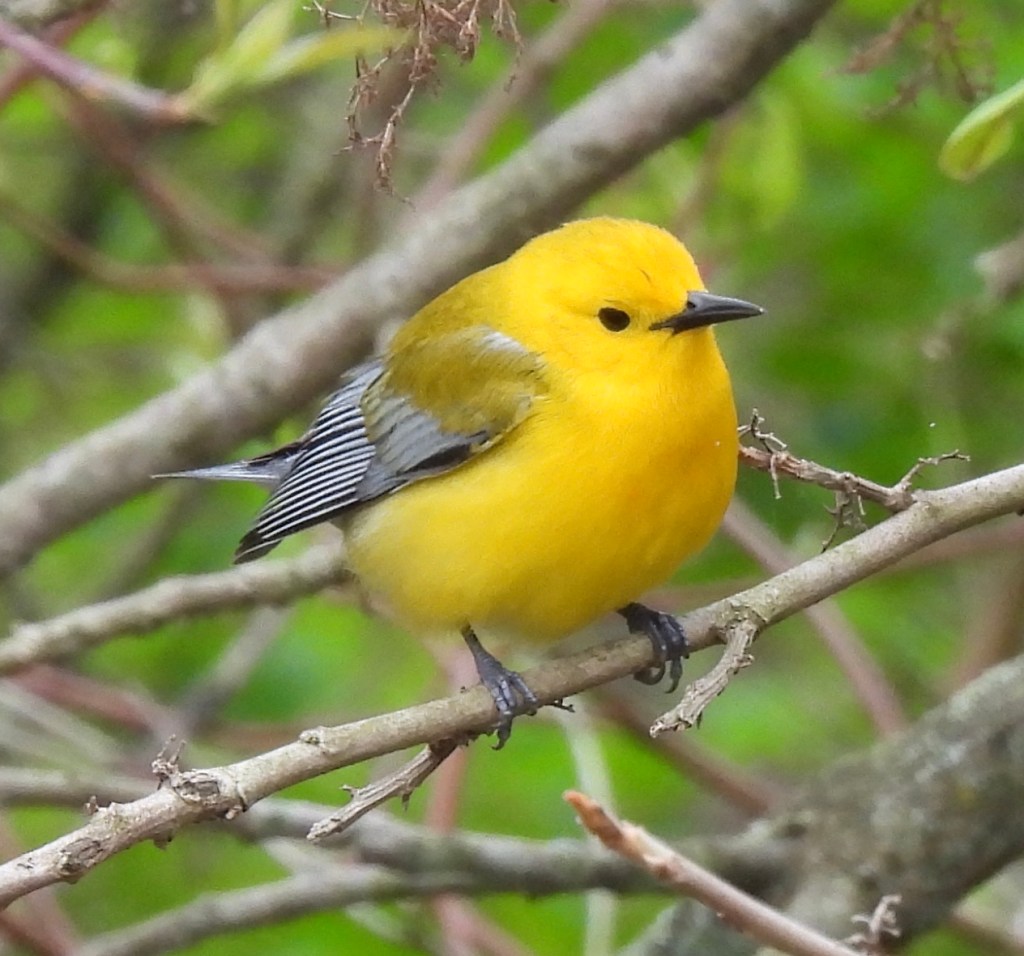
I recently got a new pair of bins, the Zeiss Conquest 10×42’s, and also a new birding camera, back with the ole reliable Nikon Coolpix 950; it’s really a beast in the field and I’ve taken so many great images with it, like the lemon below:

So, now I’m kind of back with a vengeance, and looking forward to mid-May, when all of the beauties return to our landscape to show off their colors. I’ve already scheduled an overnight to Grayling, Michigan to observe the rare Kirtland’s Warbler in its breeding habitat. Hoping that maybe I might get lucky and catch a Cerulean as well… who knows?

I’ve already begun birding at all of my old haunts, notably Portage Lakes, Summit Lake, and Fairport Harbor thus far. I’ve seen tons of Coots everywhere, and Red-breasted Mergansers appeared in notable numbers in mid-January, but have seemed to disappear. I’m not seeing anywhere near the numbers of ducks as in past years, and have yet to even see a Bufflehead, though yesterday I did catch Canvasback and Redhead individuals.

So, here we go again… lets see if we can have some fun and see lots of birds this year. I feel that everything is coming earlier than usual, and that ranges may be changing, as there had been a fair number of rares seen over the past couple of months… the Ancient Murrelet in NE Ohio-Lake Erie, and there’s still a Red-flanked Bluetail being observed in New Jersey!

Please feel free to say ‘hi’ and I’m always looking to bird with others, if you live in NE Ohio. Also please note: this website is “KeriBirder.life,” not to be confused with KeriBirder.com. 

Welcome December and Years-end…

It’s been a minute since I’ve last posted, and for that I am apologetic. It has been a rough road for me of late, as I battle my ongoing depression. No, you simply cannot take a magic pill and it goes away. No, you simply cannot wear a smile and pretend all is well and it goes away. For me, it appears to be a constant, but there is light at the end of the tunnel, and I am increasingly closer to exiting.

It’s been a year of great disappoint, and also of wonderful excitement. COVID destroyed plans for many, including me and my birding hopes, but I also made some really great new friends along the way, a couple of which stand out. The year would see my trip to Puffinhome in ruins, and also plans for my first Biggest Week in Birding Festival, among other festivals.

But I have also achieved some of my beginning objectives, including making 2020 the year of the warbler for me. I think that I ended up with 23 individual species observed, including my target species and most beautiful, the Golden-winged. Also I saw the return of my very first warbler, the Black-throated Green, which I hadn’t seen since my teens in the woodlands of Maine. I owe much of my “warblering” to my good friend, Joan Scharf, one of the luminaries of Lake County birding. Joan and I had an amazing day in mid-May at Mentor Marsh, which will always stick out in my memories for me, in addition to many trips to Lake County hotspots. Another bird not seen by me since my early teens, the Little Blue Heron made an appearance at Mentor this past spring, and I was quite fortunate to see it.

I remember starting the 2020 year off on the roadways of far western Ohio chasing down a Snowy Owl, Eurasian-collared Dove and Prairie Falcon; I ticked the Falcon, but dipped on the others. It took me three tries with 3-hour drives one way in order to see the Prairie for all of about two minutes. It was worth it, and was part of the start of my second career as a birder (not bird-watcher, noooo…. I jest!). If there is one regret that I have, it’s that I missed the entirety of the fall shorebird migration, and I love shorebirds! I just couldn’t get myself out, and the one bird I missed but wanted was a Hudsonian Godwit.

Now, I’m in the process of planning out the new year, one that will hopefully be more enriching for me as I chase down more birds. I am actively pre-planning how to get my first 100 in January, a thing here in Ohio, and will be in the fields on January 1st! I am tempted to count only the birds that I can see, versus ticking off the ones I can hear; still not sure about this more hardcore approach, but it always frustrates me when I cannot see the bird, such as the Blue-winged Warbler, which I never saw last year, but actively heard. I do hope to make much greater use of my scope in the new year as well, looking for those sea ducks, as well as the new library I put together last year.

I also have greater hopes for my blog going into the new year. I am hoping to finally begin writing reviews of birding gear, books and other stuffs, and to also provide explanations on how to bird specific hotspots and pass along tips that I’ve gotten from others. I believe in a wide open birder’s exchange, where there are no cliques or private groups, or GATEKEEPERS. We must all work together to make our hobby better and more inviting and accessible to all, not just the top 100 in Ohio. Hopefully, I can do my part in that, and if my writing brings just one new birder into the fold, I will have been successful.

Migration…

the end.

I went birding this morning for like the first time really in months, and was fortunate to see many nimble and confusing fall warblers flitting around all over, with Chimney Swifts circling above and Eagles soaring further above them. It was a beautiful first-day-of-fall morning, but likely the end of the fall migration for the most part. For warblers, I managed to catch the following: Tennessee, Nashville, Redstart, Northern Parula, Bay-breasted, Blackburnian, Blackpoll, Yellow-rumped, Black-throated Green, Black-throated Blue, Cape May, and Magnolia. Not a bad catch for a late September morning.

Sadly, there were no shorebirds in appearance. I totally missed the entire fall shorebird migration it seems. I’ve personally been in a funk since probably June, and outside of seeing the Booby this month, have not ventured out into the field at all. Yes, depression can deprive one of even their greatest passions, and sadly it cost me the entire shorebird migration season, with hopes dashed for any Godwits or Plovers. But I cannot really complain. My 2020 total stands at a respectable 197 total species for the year, a year in which I recorded 25 Warbler species, the highlight of which was getting to observe a Golden-winged Warbler in early May – sadly I did not get a pic of that one as it was extra flitty!

Time now to start planning for 2021…

Brown Booby in Ohio

Yers, that’s right! The last week of August into the first week of September, a local Ohio community served as a temporary home to a Brown Booby. Why is this special? Because the Brown Booby is typically found in the Gulf of Mexico and the Caribbean. So this immature Brown Booby was several hundreds of miles away from its typical range. Speculation is that a storm, perhaps a hurricane, carried it up to us in Ohio.

The Brown Booby above landed in my backyard, at the Nimisila Reservoir in Akron, Summit County, Ohio. It was first discovered some time around August 23rd, and was observed up to about September 3rd. Hundreds of people make the trek to Nimisila to observe the reservoir’s most famous visitor, the first sighting of this species in the State.

Sadly, nature took its course with the Brown Booby. One morning, a birder was visiting to view it and check up on it, but found no bird; instead, he discovered a single wing, floating in the waters just below the Booby’s favorite tree perch. The Booby apparently became a meal for a predator. Initial speculation was an immature Peregrine Falcon that had been harassing it earlier in the week, but that was unlikely due to the size of the Booby and the wing being left behind. Some think it was a Great Horned Owl who grabbed it in the night; owls have been known to take apart their prey. In any case, no matter who got to the Brown Booby, many were sadden by this news, including myself, as I had only just visited with it on the 1st of September. He was such a special visitor for us in a year full of disappointment. Long live the Brown Booby of Ohio, he was loved, and will be missed!