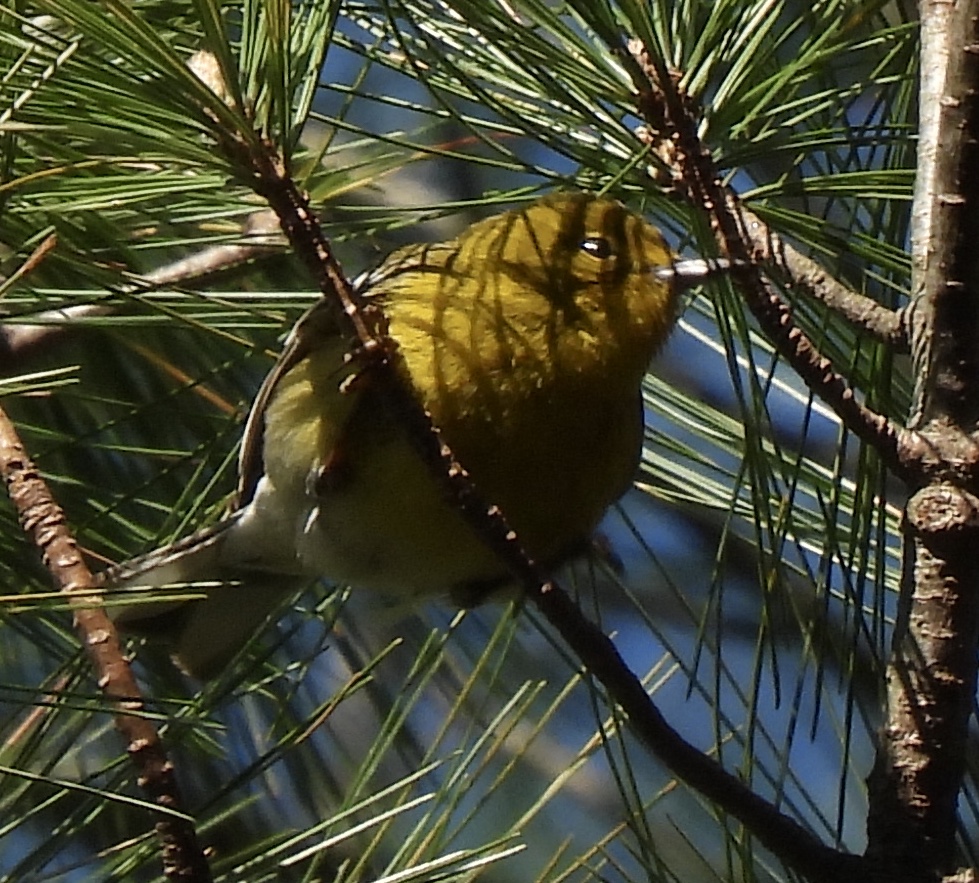
New scope incoming

So last night, I decided to take the plunge. Surfing different sites, and weighing a sales specialist’s thoughts on “reasonably priced” spotting scopes, I ordered a Vortex Viper HD 20-60×85 spotting scope. I was planning on purchasing it through Optics4Birding, which I highly recommend, but they currently have a 6-8 week backorder wait. I don’t like to wait. Now, the scope retails for $899 at almost all dealers. But, when I went to B&H Photo, they had an email connection for best price, which I hit up. The B&H price? $749, so even with sales tax, I was out at under $800, a $100 savings! And B&H offers free two-day FedEx shipping on its products, so as this seemed like a win-win for me, I ordered it.

The Vortex HD 20-60×85 angled spotting scope has a 20-60x magnification with an 85mm objective lens diameter, is 17.5″ long and weighs 4.8 lbs. It is made of ArmorTek, has a built-in sun shade, and its glass is XR fully multicoated. This scope is in fact a step down from what I had previously owned – Zeiss Victory Harpia 95 – but from all the reviews I have read and input from sales specialists, it’s supposed to be a great scope and a much more manageable price. The Harpia scope that I had currently retails for almost $5000 new, and weighs over 5 lbs. When I get my new scope and have time to take it into the field, I will post comments here about it.

So I got the scope. I checked out my current tripod, and it weighs a TON. That was the next thing that I worked on. There are so many different tripods and combinations that it’s dizzying. I looked at the Vortex carbon fiber, but got scared away from user reviews stating that it has issues with leg breaks and becoming unslotted, among other things. I looked at a couple of other brands, including Field Optics Research, Celestron, Slik, and Gitzo. It turned out that with the prices of these other companies, I could afford to purchase a Manfrotto tripod, which I love. They’re less expensive the Gitzo most of the time, and I feel just as good, if not better. What I went with is the Manfrotto MT055CXPRO3 tripod, and the Manfrotto 502AH pro video head, also ordered from B&H. Overall weight for both the tripod and head is less than 8 lbs. The tripod itself is carbon fiber, and extends to 66.9″. I’m not so sure how the spotting scope-tripod combo will work carrying into the field, but the system will be great along shorelines within a short walk from the car. Everything is expected to arrive on Thursday, which means I’ll be out on Friday testing the combo in the field, probably at Fairport Harbor State Park first.

In other news, I’m planning on attending the Shreve Migration Sensation on March 9th in Shreve and hosted by the Wilderness Center at Shreve. I’m particularly excited by the fact that Greg Miller of “BigcYear” fame will be there, and hopefully I can meet him and get a selfie! And of course there will be plenty of birding at various sites, including Killbuck Marsh and Funk Bottoms.
Cute little Owls

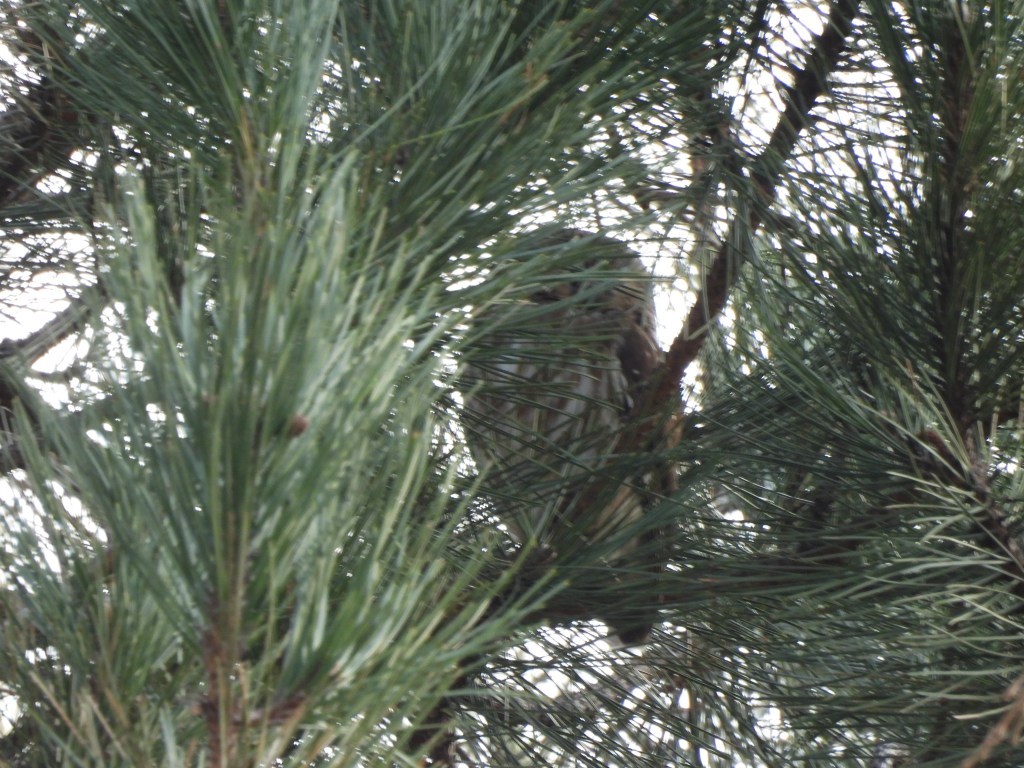
This morning, I went to the Cleveland Lakefront Nature Preserve, an 88-acre park located on Lake Erie to the west of Cleveland proper. The highlight was two Northern Saw-whet Owls, gray morph, perched high above on their respective pine trees. They are so small and so cute, and it was great to view them this morning, along with other species including immature Red-shouldered Hawk, White-throated Sparrow, Carolina Wrens and Dark-eyed Juncos bathing and playing in the streams. I then went to Fairport Harbor and got FOY Bufflehead, so it was a very good day for me. I’m now at 40 FOY species, but who’s counting. Not the best shot below, but you can see him/her….

Today I also started taking a look at getting a new, real spotting scope. I was out today with my camera, and at the high end of zoom, it did not work as well as I thought it would. I had also bought a very cheap 25-75×60 spotting scope from Temu, paid only $53 for it and figured what the hell, give it a try. It’s very dark and not unusually sharp at, well, any distance. But now, I am looking at 20-60×85 Vortex Diamondback as it’s in my price range. I was also looking at the Nikon ProStaff in the same range, and the sales associate at Optics4Birding commented that it was basically a crap scope for $599. There’s so many different models and hard to tell the differences between them.

If figuring out what spotting scope weren’t hard enough, the next pick is a tripod. Things like height and weight really matter, as well as what tripod head it comes with. Carbon fiber is the lightest, and also the most expensive, and it would be easy to buy a scope that is more expensive than the scope itself. Gitzo and Manfrotto are the most expensive tripod systems to buy, are also the lightest. Aluminum tripods are the most reasonably priced, but also heavier and sometimes not as sturdy.

So I will be evaluating all of these things while considering the purchase of a new spotting scope system.

New new year and days…

Well… its been a long time since I have written anything here. I had my absolute best year in 2020, but became disillusioned with a few things and actually quit birding since that time. I would occasionally look out for birds on my trips around the state, but no serious birding for me at all. I even sold my Zeiss spotting scope, and my beloved Zeiss Victory SF bins, which I could kick myself about. But with the opening of 2024, I’m back to birding, and I don’t really care about max numbers of species seen or any competitive stuff, I just want to see the birds.

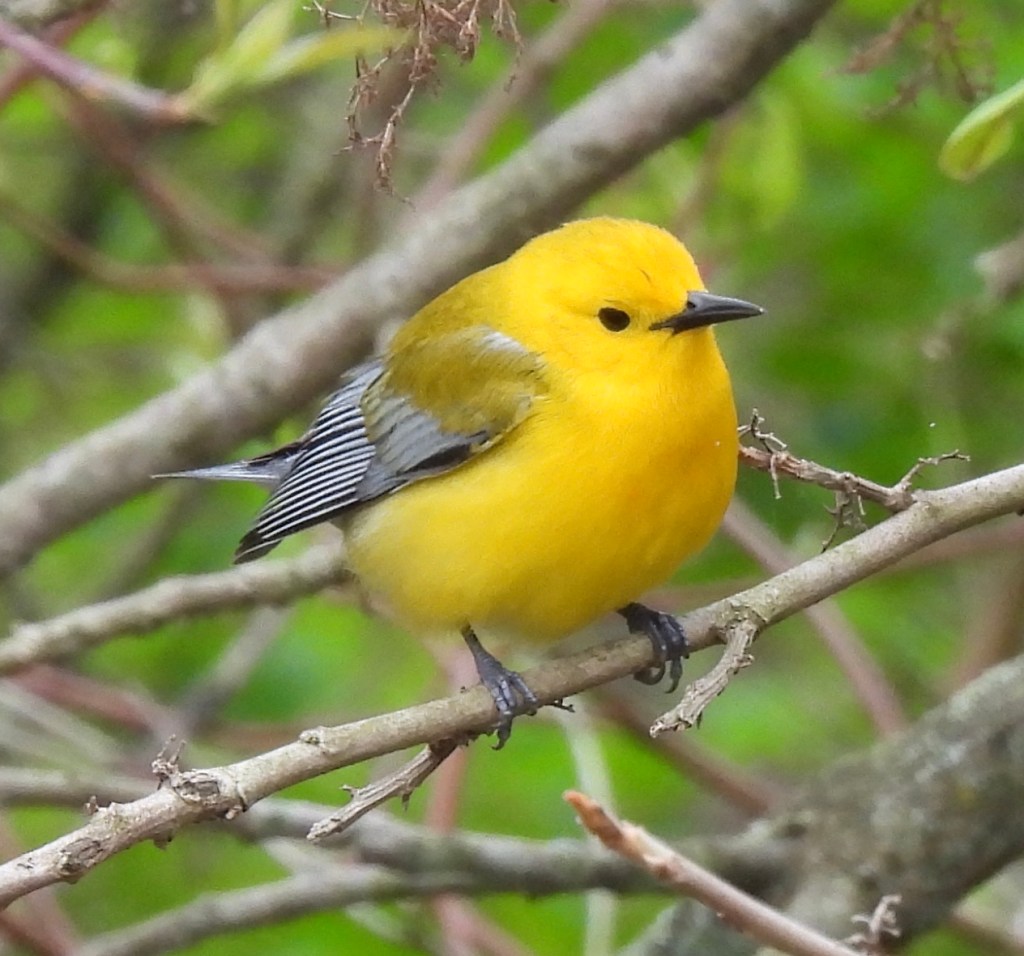
I recently got a new pair of bins, the Zeiss Conquest 10×42’s, and also a new birding camera, back with the ole reliable Nikon Coolpix 950; it’s really a beast in the field and I’ve taken so many great images with it, like the lemon below:

So, now I’m kind of back with a vengeance, and looking forward to mid-May, when all of the beauties return to our landscape to show off their colors. I’ve already scheduled an overnight to Grayling, Michigan to observe the rare Kirtland’s Warbler in its breeding habitat. Hoping that maybe I might get lucky and catch a Cerulean as well… who knows?

I’ve already begun birding at all of my old haunts, notably Portage Lakes, Summit Lake, and Fairport Harbor thus far. I’ve seen tons of Coots everywhere, and Red-breasted Mergansers appeared in notable numbers in mid-January, but have seemed to disappear. I’m not seeing anywhere near the numbers of ducks as in past years, and have yet to even see a Bufflehead, though yesterday I did catch Canvasback and Redhead individuals.

So, here we go again… lets see if we can have some fun and see lots of birds this year. I feel that everything is coming earlier than usual, and that ranges may be changing, as there had been a fair number of rares seen over the past couple of months… the Ancient Murrelet in NE Ohio-Lake Erie, and there’s still a Red-flanked Bluetail being observed in New Jersey!

Please feel free to say ‘hi’ and I’m always looking to bird with others, if you live in NE Ohio. Also please note: this website is “KeriBirder.life,” not to be confused with KeriBirder.com. 

Firestone Metro Park Guide

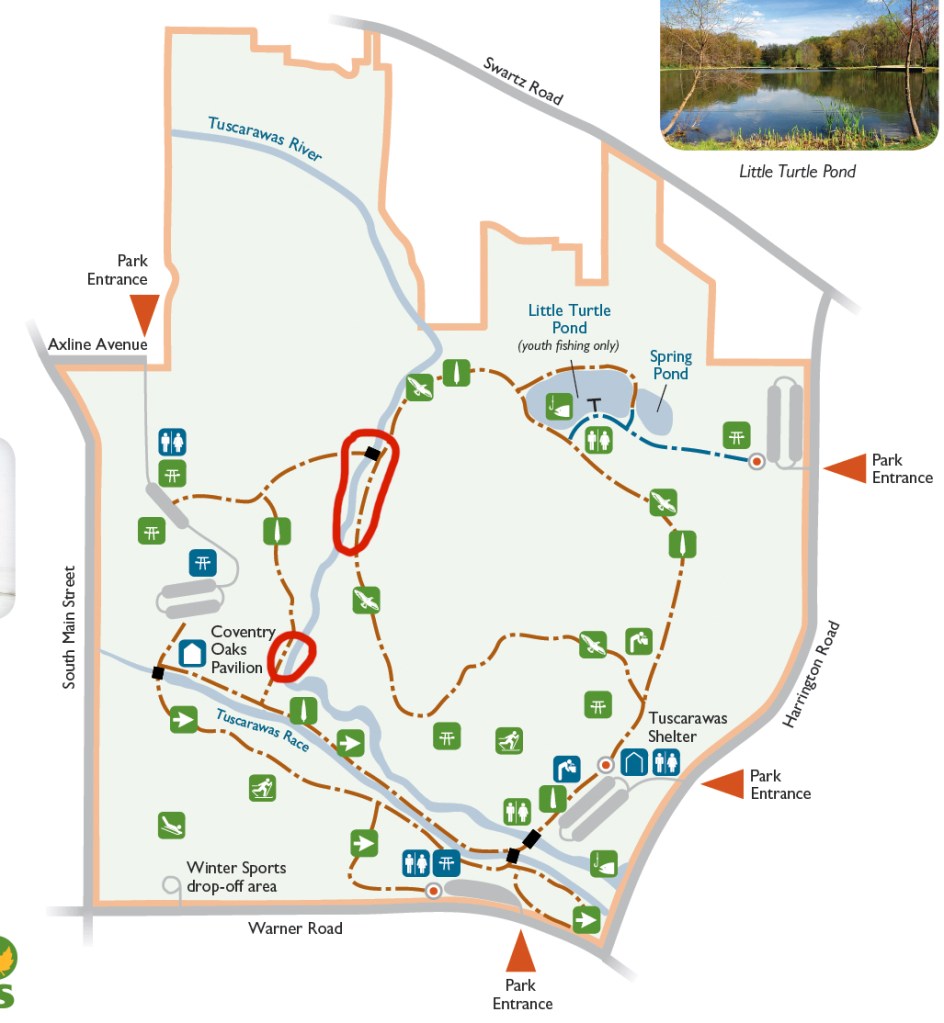
Firestone Metro Park in Summit County, Ohio, is a great place to bird locally, for all species of birds. It has a mixed environment, with various trees, bushes, trails, a river and two small ponds. I was going to bird there this spring, during the height of the warbler migration, but had never been, and didn’t know exactly where to find them, much less get around the park. So I made an acquaintance, and they provided me with some valuable information on where to go…

“Park at the lot by Tuscarawas Shelter, proceed across the bridge over the river then up the (Willow) trail between the river and race, turn right where the trail leads away from the race and goes along the river, keep going through the woods, turn right again where the trail meets the Coventry connector trail then across another bridge and turn right again (Redwing trail) which takes you to the boardwalk (not shown on the map).” The two circled areas are the spots to see warblers!

Welcome December and Years-end…

It’s been a minute since I’ve last posted, and for that I am apologetic. It has been a rough road for me of late, as I battle my ongoing depression. No, you simply cannot take a magic pill and it goes away. No, you simply cannot wear a smile and pretend all is well and it goes away. For me, it appears to be a constant, but there is light at the end of the tunnel, and I am increasingly closer to exiting.

It’s been a year of great disappoint, and also of wonderful excitement. COVID destroyed plans for many, including me and my birding hopes, but I also made some really great new friends along the way, a couple of which stand out. The year would see my trip to Puffinhome in ruins, and also plans for my first Biggest Week in Birding Festival, among other festivals.

But I have also achieved some of my beginning objectives, including making 2020 the year of the warbler for me. I think that I ended up with 23 individual species observed, including my target species and most beautiful, the Golden-winged. Also I saw the return of my very first warbler, the Black-throated Green, which I hadn’t seen since my teens in the woodlands of Maine. I owe much of my “warblering” to my good friend, Joan Scharf, one of the luminaries of Lake County birding. Joan and I had an amazing day in mid-May at Mentor Marsh, which will always stick out in my memories for me, in addition to many trips to Lake County hotspots. Another bird not seen by me since my early teens, the Little Blue Heron made an appearance at Mentor this past spring, and I was quite fortunate to see it.

I remember starting the 2020 year off on the roadways of far western Ohio chasing down a Snowy Owl, Eurasian-collared Dove and Prairie Falcon; I ticked the Falcon, but dipped on the others. It took me three tries with 3-hour drives one way in order to see the Prairie for all of about two minutes. It was worth it, and was part of the start of my second career as a birder (not bird-watcher, noooo…. I jest!). If there is one regret that I have, it’s that I missed the entirety of the fall shorebird migration, and I love shorebirds! I just couldn’t get myself out, and the one bird I missed but wanted was a Hudsonian Godwit.

Now, I’m in the process of planning out the new year, one that will hopefully be more enriching for me as I chase down more birds. I am actively pre-planning how to get my first 100 in January, a thing here in Ohio, and will be in the fields on January 1st! I am tempted to count only the birds that I can see, versus ticking off the ones I can hear; still not sure about this more hardcore approach, but it always frustrates me when I cannot see the bird, such as the Blue-winged Warbler, which I never saw last year, but actively heard. I do hope to make much greater use of my scope in the new year as well, looking for those sea ducks, as well as the new library I put together last year.

I also have greater hopes for my blog going into the new year. I am hoping to finally begin writing reviews of birding gear, books and other stuffs, and to also provide explanations on how to bird specific hotspots and pass along tips that I’ve gotten from others. I believe in a wide open birder’s exchange, where there are no cliques or private groups, or GATEKEEPERS. We must all work together to make our hobby better and more inviting and accessible to all, not just the top 100 in Ohio. Hopefully, I can do my part in that, and if my writing brings just one new birder into the fold, I will have been successful.

Migration…

the end.

I went birding this morning for like the first time really in months, and was fortunate to see many nimble and confusing fall warblers flitting around all over, with Chimney Swifts circling above and Eagles soaring further above them. It was a beautiful first-day-of-fall morning, but likely the end of the fall migration for the most part. For warblers, I managed to catch the following: Tennessee, Nashville, Redstart, Northern Parula, Bay-breasted, Blackburnian, Blackpoll, Yellow-rumped, Black-throated Green, Black-throated Blue, Cape May, and Magnolia. Not a bad catch for a late September morning.

Sadly, there were no shorebirds in appearance. I totally missed the entire fall shorebird migration it seems. I’ve personally been in a funk since probably June, and outside of seeing the Booby this month, have not ventured out into the field at all. Yes, depression can deprive one of even their greatest passions, and sadly it cost me the entire shorebird migration season, with hopes dashed for any Godwits or Plovers. But I cannot really complain. My 2020 total stands at a respectable 197 total species for the year, a year in which I recorded 25 Warbler species, the highlight of which was getting to observe a Golden-winged Warbler in early May – sadly I did not get a pic of that one as it was extra flitty!

Time now to start planning for 2021…

Brown Booby in Ohio

Yers, that’s right! The last week of August into the first week of September, a local Ohio community served as a temporary home to a Brown Booby. Why is this special? Because the Brown Booby is typically found in the Gulf of Mexico and the Caribbean. So this immature Brown Booby was several hundreds of miles away from its typical range. Speculation is that a storm, perhaps a hurricane, carried it up to us in Ohio.

The Brown Booby above landed in my backyard, at the Nimisila Reservoir in Akron, Summit County, Ohio. It was first discovered some time around August 23rd, and was observed up to about September 3rd. Hundreds of people make the trek to Nimisila to observe the reservoir’s most famous visitor, the first sighting of this species in the State.

Sadly, nature took its course with the Brown Booby. One morning, a birder was visiting to view it and check up on it, but found no bird; instead, he discovered a single wing, floating in the waters just below the Booby’s favorite tree perch. The Booby apparently became a meal for a predator. Initial speculation was an immature Peregrine Falcon that had been harassing it earlier in the week, but that was unlikely due to the size of the Booby and the wing being left behind. Some think it was a Great Horned Owl who grabbed it in the night; owls have been known to take apart their prey. In any case, no matter who got to the Brown Booby, many were sadden by this news, including myself, as I had only just visited with it on the 1st of September. He was such a special visitor for us in a year full of disappointment. Long live the Brown Booby of Ohio, he was loved, and will be missed!

Some Useful Guides

I thought that I would share a list of the books that I rely upon for identification and descriptors, including behavior, etc. This is my current list as of today, and includes identification and behavioral books only:

Birds of Massachusetts and Other New England States, Vols I-III by Edward Howe Forbush.

The Cornell Lab of Ornithology Handbook of Bird Biology by Lovett and Fitzpatrick.

The Crossley ID Guide: Eastern Birds by Richard Crossley.

Gulls Simplified: A Comparative Approach to Identification by Dunne and Karlson.

Peterson Reference Guide to Woodpeckers of North America by Stephen Shunk.

Shorebirds of North America, The Photographic Guide by Dennis Paulson.

Shorebirds: An Identification Guide by Hayman, Marchant, and Prater.

The Sibley Field Guide to Birds of Eastern North America by David Sibley.

The Warbler Guide by Stephenson and Whittle.

What It’s Like To Be A Bird by David Sibley.

I’m not going to comment on specifics of bird guides at this point, although I do eventually intend to provide reviews of books shortly. This list also does not include other birding-related books, such as Kenn Kaufman’s wonderful “A Season On The Wind.” What are some of your favorite birding guides?

First Publishing…

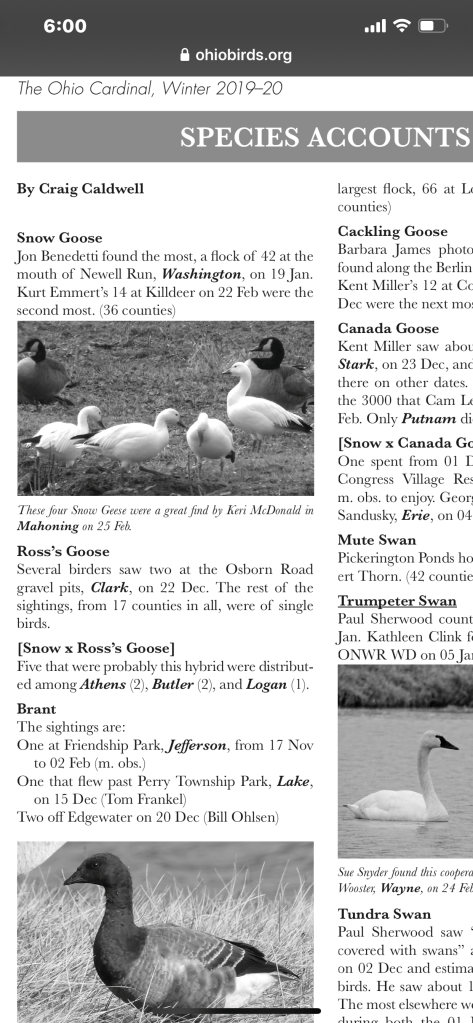
I am a member of the Ohio Ornithological Society, and I was proud to notice that, in their latest edition of their publication “The Cardinal: Winter 2019-2020,” I had an entry included. In the winter of 2020, I got the opportunity of observing Snow Geese in Mahoning, Ohio – I must say that they were initially found by another birder. A friend, who happens to be the Photo Editor, mentioned they were looking for images, so I submitted my Snow geese:

Even though my name was mis-spelled, it was a nice recognition, albeit a small one in a year filled with relative disappointment. This week, I was to have been in Maine attending the Audubon Society’s Hog Island Field Ornithologist workshop, and finally observing Puffins.

Spring is Over

So in northern Ohio, we had been expecting a last, final wave of spring migrants, again based upon data from the Black Swamp Bird Observatory (BSBO) website. It seems that it came, and went just as quickly.

Numerous reports abounded yesterday of a great number of birds along the shores of Lake Erie. From Wendy Park in Cleveland, to Erie Street Cemetery, to Headlands Dunes State Park, there were reports of large numbers of migrants, both on Saturday and Sunday. Saturday even saw the discovery of a Scissor-tailed Flycatcher at Wendy Park. My birding friend, Joan Scharf, reported a good number of passerines at Headlands Dunes yesterday, and today is dad dead. Everything has moved along, having stopped to stoke up for two days. I had a decent morning – for me – at Headlands, with Great Crested Flycatcher, Eastern Kingbird, several Least Flycatcher, Scarlet Tanager, Blackpoll Warbler, Chestnut-sided Warbler, numerous Yellow Warbler, and several Vireos, especially Red-eyed.

Warbler reports were especially good at Wendy Park, according to eBird reports, with lots of variety and number. There were even sightings of three Connecticut Warblers and also Mourning Warblers, in addition to the Scissor-tailed Flycatcher. There were huge numbers of Yellow-bellied and Willow Flycatchers, a push of over 700 estimated Cedar Waxwings, and 21 varieties of warbler. These numbers have fallen off significantly today.

So, it would seem that the third, and final, projected spring migration wave has come, and gone. No doubt there’ll be some ‘clean-up,’ but most of the birbs have moved along to their northern nesting grounds, and only fall awaits, for their return through to winter.